

Easy, tastier coffee

The goal of this site is to improve your coffee.
Under-extracted coffee is sour, and over-extracted coffee is bitter.
You can easily and quickly fix sour or bitter coffee using recipes on this site.
Don’t waste half the bag of beans trying to make a nice cup of coffee.
Method.coffee gives you:
- Recipes: Instead of one recipe that can’t work for every roast level, method.coffee provides 120 recipes that cater to every roast level. The recipes use SCA standards. They are the recipe adjustments that a very experienced barista would use.
You can read more about Roast Levels and Recipes here. - Adjustments: Grind size changes are great for getting your extraction time about right, but they are terrible for changing the level of extraction. They can’t cover the extraction requirements for the full range of roast levels, making dialling in difficult and often impossible.
Changing the recipe is much more effective, caters to the entire roast level range, and is quick. - Starting recipe: Instead of always using the same recipe that will probably only work less than 10% of the time, you can find an initial recipe that will work 68% of the time, and 95% of the time only requires a single recipe change, reducing dialling-in time.
- Taste: The biggest benefit is that you are finally using your taste buds to adjust the coffee. You find the recipe that tastes the best.
Resulting in better tasting coffee.
As Lucia Solis says, “Life’s too short to drink bad coffee.”
Collectively, this method of extracting coffee with the help of recipes generated by density measurements, adjustments made to the recipe, and starting with a recipe based on density is known as the Continual Improvement Method (CIM). A catchy acronym like WDT or RDT 😉
About the logo
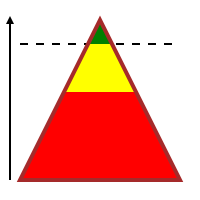
If all the people who make fresh coffee are represented in a pyramid, the vertical axis is the ability to execute. The dashed line is the bar. Below this line, you really can’t make the best of every bag of coffee that might come your way.
The bulk of the people are way down in the red. A much smaller group can do a bit better, sometimes – they are the yellow section. Still, they really cannot execute all the coffee well.
Very few people possess the skills and knowledge to truly maximise the potential.
Why is it so hard? It is the current method.
The one recipe method has evolved from tradition, and it is really holding you back.
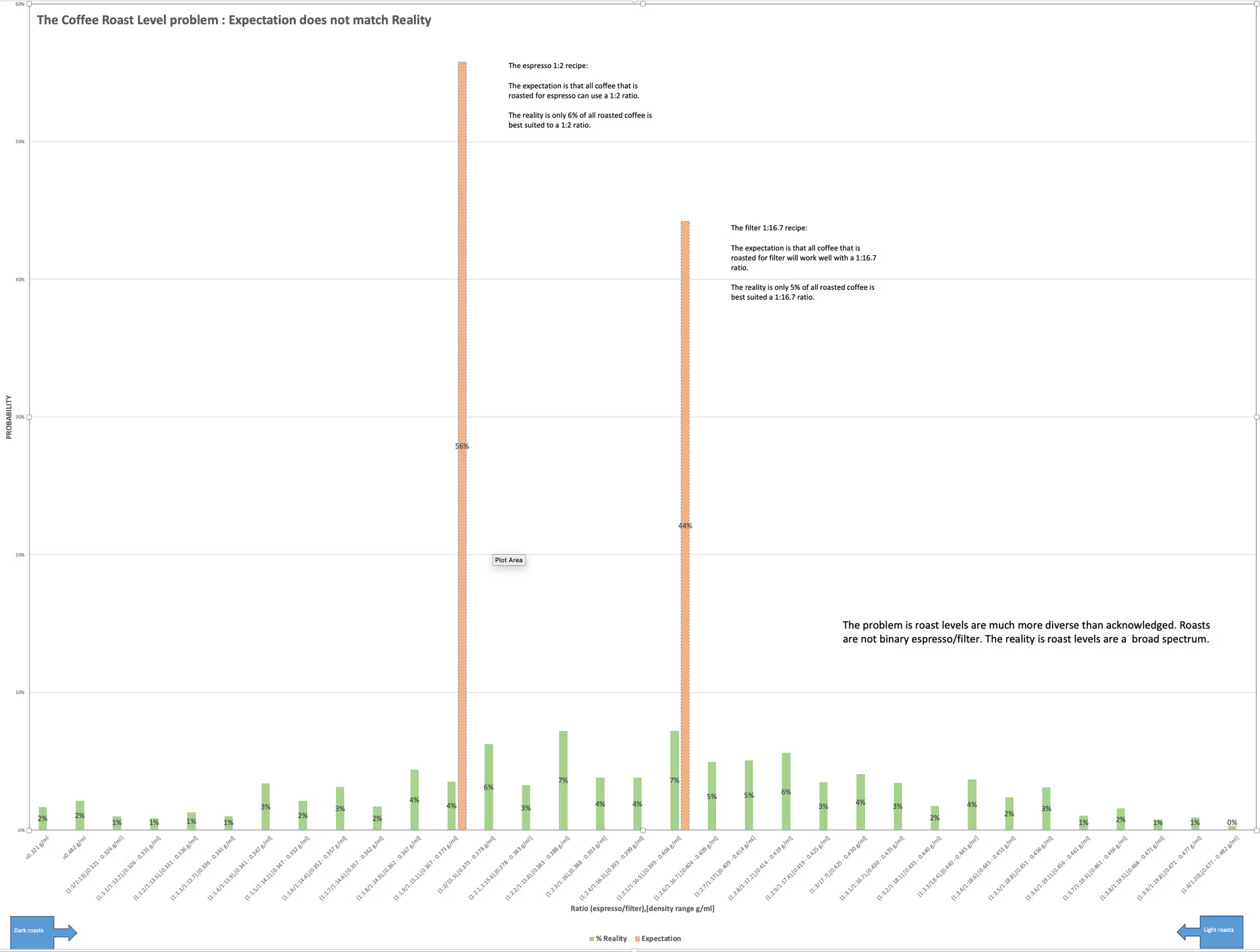
Most people make espresso using a single fixed recipe.
(SCA) Our research suggests that the average barista uses a 1:2 brew ratio when extracting espresso and uses weight for output measurement. The average shot of espresso starts with an 18–20 gram dose, has an output of 36.5 grams, and is extracted in 25–30 seconds, at 9 bars of pressure and 200°F, using pre-infusion, through an 18-gram basket. (source).
Grind size is adjusted to achieve the 25-30 second time.
How most people make filter coffee is one single, Fixed Recipe:
Coffee-to-Water Ratio: To achieve the Golden Cup Standard, the recommended coffee-to-water ratio is 55 g/L ± 10%. (a ratio of 1:18)
An alternative everyday recipe is 60 g/L, which has a ratio of 1:16.
Coffee Preparation Temperature: To achieve the Golden Cup Standard, water temperature at the point of contact with coffee is recommended to fall between 200°F ± 5° (93.0°C ± 3°).
Not varying the ratio, temperature or the other parameter ranges available.
No adjustments for taste. If it doesn’t taste good, blame the roaster and try a different blend that suits your taste.
The red base of the pyramid above represents this case.
Some people do have all the gear and use the advice only to change one thing at a time. Typically, this is only the grind size, and it is used solely to achieve a predetermined extraction time.
If it doesn’t taste good, blame the roaster and try a different blend that suits your taste.
The yellow midsection of the pyramid represents this case.
The number of possible permutations of changes to an espresso recipe is in the millions.
| Parameter | Range | Number |
|---|---|---|
| Grind sizes | 250-350 | 100 |
| Temp | 85-95 | 10 |
| Dose | 14-25 | 11 |
| Time | 20-40 | 20 |
| Yield | 25-56 | 31 |
| Permutations | 6,820,000 |
The huge number of possible parameter combinations in recipes is represented by the yellow rays in the logo.

The problems
- Not knowing that roasted coffee has quite variable solubility and requires different recipes.
- Not using all the tools to their fullest extent.
The result is that most people lack the skills and experience to make the best of every bag of coffee.
The bar
The 50 top Baristas in the world spend a year perfecting a single cup of coffee, then compete to win the World Barista Championship (WBC).
The green tip of the pyramid represents these extraordinary people.
Most of us fall short of the mark in terms of our ability to execute.
The problem is that roast levels are much more diverse than acknowledged. Roasts are not binary espresso/filter. The reality is that roast levels are a broad spectrum.
The solubility of the coffee varies hugely across that range. You need to use very different recipes to achieve a good-tasting result. It’s just not possible to use one recipe for everything and expect it to work.
Coffee roasting is nowhere near as accurate and reproducible as customers think. Nor can it be, there is enormous variability in the green beans themselves. What you need is a better method that makes it easy to cope with variability.
CIM Continual Improvement Method
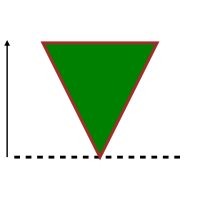
CIM method turns everything on its head.
- Instead of 1 recipe, there are 120.
- Instead of changing one thing at a time, change everything, the entire recipe.
This is represented by inverting the triangle.
method.coffee statistically samples the ~30 billion bags of roasted coffee each year into a Large Coffee Model (LCM), continually refining the Roasted Coffee Range (RCR).
The site continually refines the Parameters (ratio, dose, temp etc) for each coffee method (espresso, v60, Aeropress, French Press, etc.).
The LCM mathematically linearly maps the collected parameters against the collected RCR, generating a series of recipes that are effective right across the range.
All information on this site is designed for continual improvement; the site is continually evolving, the more it is used, the better it gets.
A simple, quick, and cheap method helps you select the best starting recipe for your bag of coffee. It is a bit like weather prediction, it may not be perfect first time, but it will get you a lot closer to where you need to be. More importantly it then gives you a much more effective tool to make changes.
Adjustments according to your taste
You don’t need to know what all the tool settings are, all you need to do is taste it. If it’s sour and you need to extract more, use a higher recipe in the sequence. If it’s bitter and you need to extract less, use a lower recipe in the sequence. It’s quick to resolve problems and find the best-tasting recipe for every bag of coffee.
Now, everyone can make every bag of coffee taste better according to their taste, all their extractive tools are used to the fullest extent.
Now, everyone is in Green; the bar has been raised for everyone.
So that explains the inverted triangle, a method that turns everything on its head. The rays represent the different changes, settings, and permutations that you could be making, that would require years of skill; now they are being made for you by the series of recipes.
The logo may look suspiciously similar to the Eye of Providence, a symbol associated with the Illuminati.
Individuals claiming to possess special enlightenment or knowledge of a particular subject. Some mysterious standard known only to the illuminati of the organisation.
But the pyramid is inverted, and it is a coffee bean, not an eye, so there the similarity ends.
Extracting coffee is much like cooking meat.
- Fillet steak is beautiful if seared for a few minutes on each side.
- Brisket is beautiful if slow-cooked for 6 hours.
Using one fixed recipe for cooking all meat will not produce the best result.
Coffee is no different.
- Dark-roasted coffee is not very dense. It is pretty brittle; you can crush it with your fingertips. The fixed recipe is likely to over-extract and make very bitter coffee.
- Light-roasted coffee is very dense; a hammer will bounce off it. It is hard to extract. The fixed recipe is likely to under-extract and make sour coffee.
Using one fixed recipe for extracting all coffee will not produce the best result for every coffee.
Method.Coffee provides 120 recipes, and if you choose to measure your bean density, you can, in less than 1 minute, select the recipe likely to suit your beans.
Why does measuring density make better coffee?
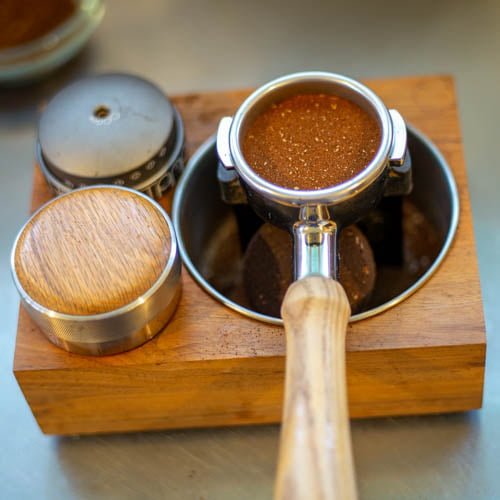
Easy coffee recipes to make at home
One hundred and twenty recipes ordered from extract the least (1) to extract the most (120), where the extraction required is scaled to match the Roast Level.
Measuring the roasted coffee density will provide a much better-starting recipe for your coffee extraction than using one fixed recipe every time.
If you are interested in the density range and the calculations that generate the 120 recipes, read more here.
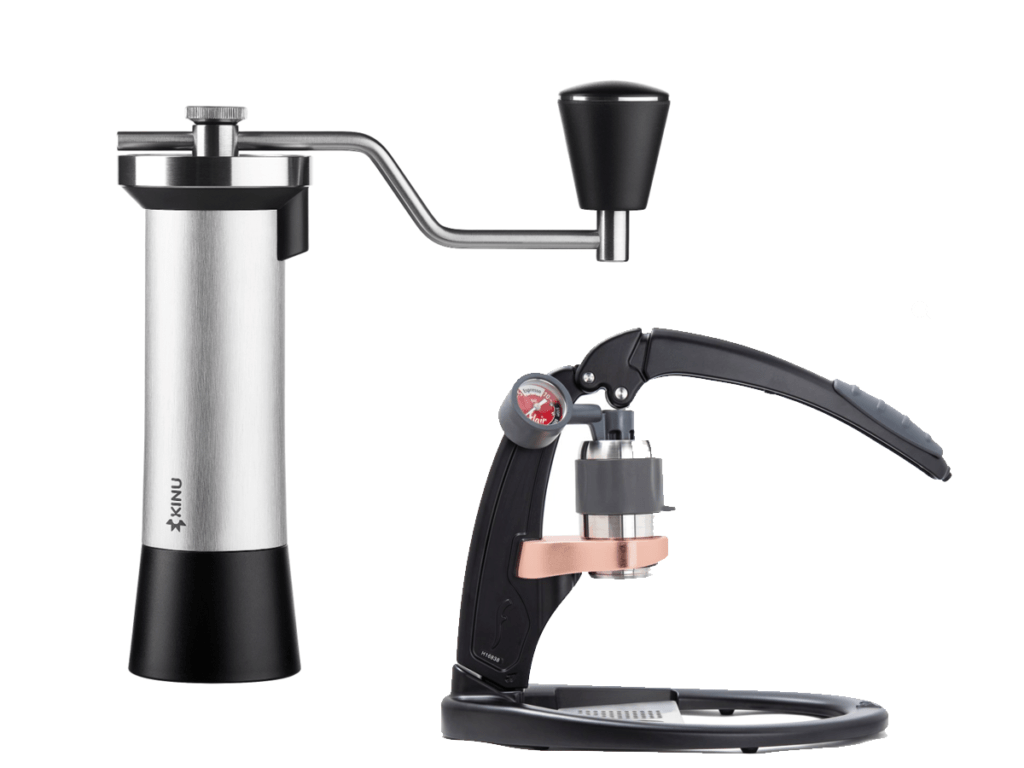
How to dial in coffee
Grinding finer will extract more, but you can’t go far before it chokes the shot.
Grinding coarser will extract less, but you can’t go far before there is not enough puck pressure and the shot runs too fast. However, changing the recipe changes every extraction variable. It is a more effective adjustment that makes dialing in your coffee much quicker and easier.
How to use this site
The dialing-in method with CIM is unique. When you taste the coffee:
– if the coffee is sour, you extract quite a bit more by next trying a recipe 20 places up the series.
– if the coffee is bitter, you extract quite a bit less by next trying a recipe 20 places down the series.
There are two methods of using the site:
Method 1: Without a 100ml cylinder. You don’t have to measure your coffee beans’ density. Use the default (median) starting recipe of 390 (0.390g/ml recipe #61).
68% of the roasted coffee on the planet falls within two tries in either direction, using the Extract More or Extract Less buttons. The remaining 30% of coffees may take up to a total of 4 attempts with this method. But at least you can try the recipes with no extra gear. You don’t have to make the coffees all in one go; just mentally note the result and what you want to try next time.
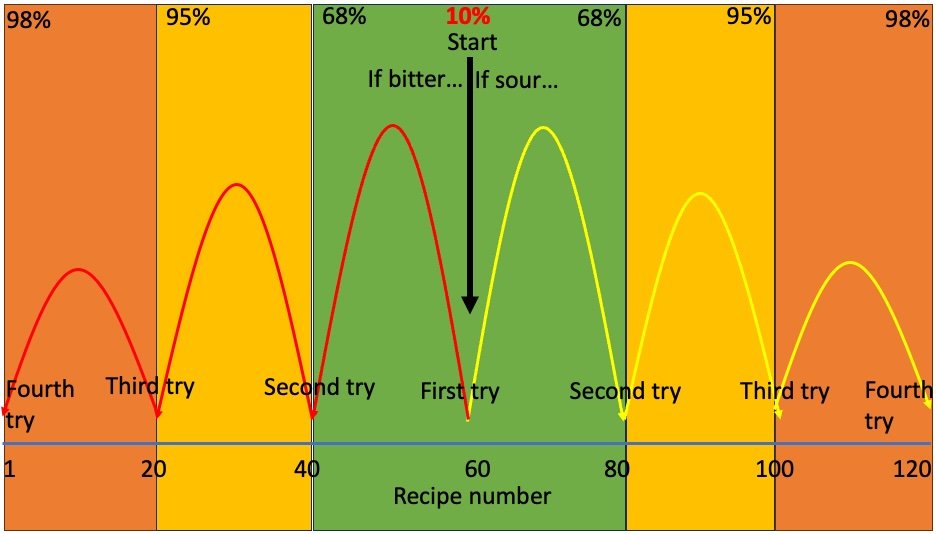
Method 2: With a 100ml cylinder and 0.1g scales. Making a great coffee is much quicker if you get a 100ml cylinder because 68% of the time, you will make a brilliant coffee on the first attempt — 95% with up to one adjustment and 98% with up to two adjustments.
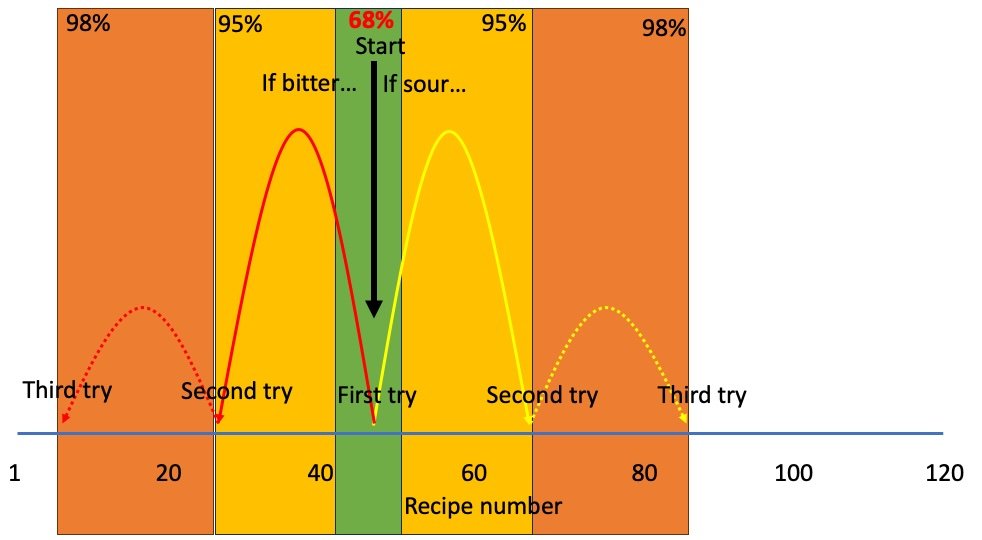
In this example, your measured density is 0.377 g/ml. Entering 377 in the form above gives you a starting recipe of #48.
There is a 68% probability that this recipe will be correct the first time because it is based on a density measurement of your beans.
It still could be off 30% of the time, but you will already be in the right ballpark, so 95% of the time, you will only need to change a single recipe, either up or down.
Method 2 can be up to four times faster than method 1. This is a significant return on investment for a cheap and quick-to-use tool. Method 2 also has the added benefit of your measurements further improving the density of the coffee model. The more measurements entered, the more accurate the model becomes, resulting in better recipes.
The huge advantage of the series of recipes is that they help you fully utilise all your extraction tools to their total capacity – without having years of barista training. And you always end up with a coffee that tastes the best, the least sour and the least bitter. The best recipe for your coffee. A revelation.
If you start measuring your density, the system will be super-fast in finding the best recipe.
CIM, it’s a revolution in making coffee.
Measure the density
It takes less than 1 minute, and the tool is cheap.
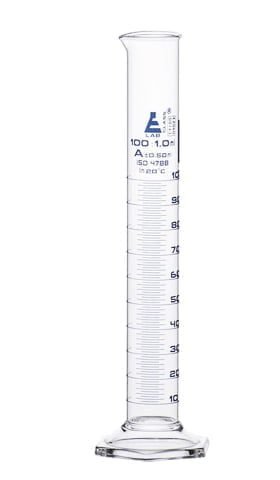
Fill in the form
Get the recipe by entering your measured density into the calculation form and clicking Submit.
Select method
Select from Espresso, Filter, Aeropress, or Hario Switch.
Make your initial coffee
Using the recipe provided, make your first coffee.
Taste it
Empirically, 68% of the time, the coffee extraction will be correct on the first try. 95% works after one adjustment. 99.7% works after two adjustments.
All you need to decide is:
- Is it too sour, like lemon? In this case, you need to extract more.
- Is it OK? You don’t need to change anything. Some refer to this as the sweet spot, but coffee doesn’t contain sugar, so think of this as the calm between too sour and too bitter.
- Is it too bitter? All coffee is bitter to some extent, but you can reduce the bitterness by extracting less.
Adjustments
Either
- Use the Extract More button (adds 20 to the measured density).
- Use the Extract Less button (subtract 20 from the measured density).