


Espresso Shaker Funnel
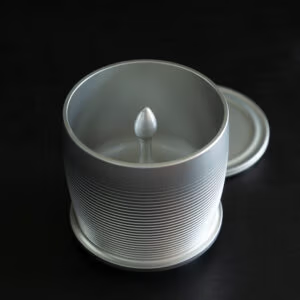
What Are Espresso Shaker Funnels?
Espresso shaker funnels are specialized coffee brewing accessories designed to improve the preparation of espresso shots by evenly distributing and homogenizing ground coffee beans. They combine the functions of a dosing funnel (to catch grounds from the grinder without mess) and a shaker (to redistribute the grounds, breaking up clumps and ensuring uniform density). This is crucial in espresso making because uneven distribution can lead to channeling—where water finds paths of least resistance during extraction, resulting in bitter, sour, or weak shots. These tools are popular among home baristas and professionals for streamlining workflow, reducing retention (grounds stuck in the device), and enhancing flavor consistency.
They evolved from simpler tools like the “Blind Shaker” or “Blind Tumbler,” originally designed for specific grinders like the Mahlkönig EK43 (often called the HG-1 in coffee circles). Modern versions are more versatile, fitting standard portafilter baskets.
History and Evolution
The concept traces back to the late 2010s in the specialty coffee community, where baristas sought ways to mimic the even distribution achieved by high-end commercial grinders. The “Blind Tumbler” from Craig Lyn Design Studio (around 2018–2020) was an early iteration: a lidded cup for shaking grounds blindly before dosing. It addressed issues like static clumping in finer grinds.
By 2021, this evolved into the Espresso Shaker Funnel (ESF), integrating a funnel shape for direct grinding and dosing. Innovations focused on materials (e.g., polished interiors for less stickiness), ergonomics (grippy ridges), and compatibility (multi-size flanges). Brands like MHW-3BOMBER introduced conical designs in 2023–2024 for “tap-free” distribution, while community feedback on forums like Reddit’s r/espresso refined designs to minimize mess and improve shake efficiency.
As of 2025, they’re a staple in home setups, with prices ranging from $20–$90, reflecting premium materials and features.
How They Work
Using an espresso shaker funnel typically follows a simple 4-step process:
1. Grind Directly In: Place the funnel over your portafilter or a knock box. Grind your dose (e.g., 18–20g) straight into it. The wide mouth catches everything, minimizing spills.
2. Seal and Shake: Snap on the lid (often friction-fit or magnetic). Shake vigorously for 5–10 seconds—side-to-side or up-and-down—to redistribute fines (tiny particles) and break clumps. Some designs include a central plug or cone that agitates during shaking.
3. Tap and Settle: Gently tap the bottom on a counter to level the bed. This helps grounds settle evenly without compacting.
4. Dose and Tamp: Remove the lid/plug and pour (or slide) grounds into the portafilter basket. Tamp evenly for a flat puck. Optional: Follow with a Weiss Distribution Technique (WDT) tool for extra precision.
This method promotes a uniform coffee bed, improving extraction evenness and reducing channeling risks. It’s faster than manual stirring and cleaner than dumping loose grounds.
Key Features and Design Variations
Espresso shaker funnels vary by brand, but common features include:
Materials: Anodized aluminum, acetal plastic, or stainless steel (SUS304) for durability, food safety, and easy cleaning. Polished interiors reduce retention.
– Lids/Plugs: Friction-fit caps, magnetic seals, or pull-out plugs to contain grounds during shaking.
– Flanges/Bases: Adjustable rims to fit baskets (49–58mm standard). Some have magnetic bases for stacking with other funnels.
– Extras: Mesh filters (150–350µm) for sifting fines; ridges for grip; convex lips to prevent accidental spills.
| Brand/Model | Basket Size | Key Features | Price Range (USD, approx. 2025) | Notable Pros/Cons |
|————-|————-|————–|——————————–|——————-|
| **Craig Lyn ESF I** | 58mm | Wide flange for stability, exterior ridges for grip, aggressive plug profile for fast emptying, polished interior. Evolved from Blind Tumbler. | $40–50 | Pros: Excellent retention control, lightweight. Cons: Single-size only. |
| **Craig Lyn ESF II** | 49–58mm | Dual flanges for multi-size fit, smaller plug opening for compact baskets. | $45–55 | Pros: Versatile for multiple machines. Cons: Slightly less stable on larger baskets. |
| **MHW-3BOMBER SE Pro** | 58mm | Conical design for uniform layering without tapping, wide 6.4cm mouth, lifting rod for easy operation. Red Dot winner. Fits non-angled ears (outer dia. <73mm). | $80–90 | Pros: Effortless, spill-proof. Cons: High retention in crevices; shaking mechanism criticized as ineffective. |
| **MHW-3BOMBER Basic Shaker** | 58mm | Simple dosing cup with smooth walls, used as receiver or measuring tool. | $25–35 | Pros: Affordable, multi-use (e.g., pour-over). Cons: Less advanced shaking. |
| **S’Works Design Shaker Funnel** | 58mm | Acetal slider for grinder compatibility, magnetic cap/base, optional mesh filters, 30mm drop height. | $30–40 | Pros: Customizable filters, smooth insertion. Cons: Requires base for centering with other funnels. |
| **Decent Espresso Funnel** | 58mm (standard) | Heavy anodized aluminum, sits on outer rim (no grind-free gaps), finger curve for easy lift. | $20–30 | Pros: Stable for shaking, promotes WDT. Cons: Basic, no lid for shaking. |
Benefits and Drawbacks
**Benefits**:
– **Consistency**: Even distribution leads to balanced extractions, unlocking fuller flavors (e.g., brighter acidity, less bitterness).
– **Efficiency**: Cuts prep time vs. manual methods; reduces mess on counters.
– **Versatility**: Works with electric/manual grinders; some double as measuring cups.
– **User Feedback**: Many report better shots without WDT, especially for beginners.
**Drawbacks**:
– **Learning Curve**: Shaking technique matters—too vigorous can compact fines.
– **Retention**: Some models trap grounds in crevices, requiring brushing.
– **Cost vs. Value**: Premium ones ($80+) face criticism for overhyping (e.g., MHW’s “shaker” not sealing fully).
– **Not Essential**: Experts like Scott Rao emphasize WDT over shakers, and some users prefer simple taps/funnels.
Where to Buy and Community Tips
Available on brand sites (e.g., craiglyn.com, mhw3bomber.com), Amazon, or specialty shops like Cafuné Boutique. Check compatibility with your portafilter (e.g., E61, La Marzocco).
Tips from r/espresso users:
– Pair with a spacer funnel for overflow prevention.
– Weigh doses post-shake to track retention (aim <0.5g).
– Clean after each use; hand-wash only.
– For best results, grind slightly coarser and adjust based on taste.
If you’re new to espresso, start with a budget model like Decent’s—it’s forgiving. For pros, Craig Lyn’s ESF offers the best balance of form and function. Experiment to see if it fits your ritual!